AI Project
The Crypto Trail
You have died of dysentery. Except it's 2021, the dysentery is hemorrhoids from sixteen-hour chart sessions, and the wagon is a leveraged long. A satirical survival game across the entire 2020–2025 crypto cycle — built in six days.
LiveOregon Trail worked because the frontier actually killed people, and the game refused to be sentimental about it. The Crypto Trail takes the same posture toward a cycle most of us lived through: cold, deadpan, and completely unwilling to tell you that you made a reasonable decision.
You pick a class, a city, and a political party, and then you advance one week at a time from January 2020 to March 2025. The historical beats are fixed and the numbers are variable, so the Ronin hack always lands — it's just a question of whether you were in it. Health, sanity, heat, debt, and reputation all decay in their own directions. Heat never goes down. At 100, the knock.
Six days, 246 commits, roughly 8,300 lines across 61 files. Nearly two thirds of that is written content rather than engine code — over 600 authored choices across 300+ event scenes — which is the honest reason it reads less like a simulation and more like a very long, very mean joke that happens to have a portfolio attached.
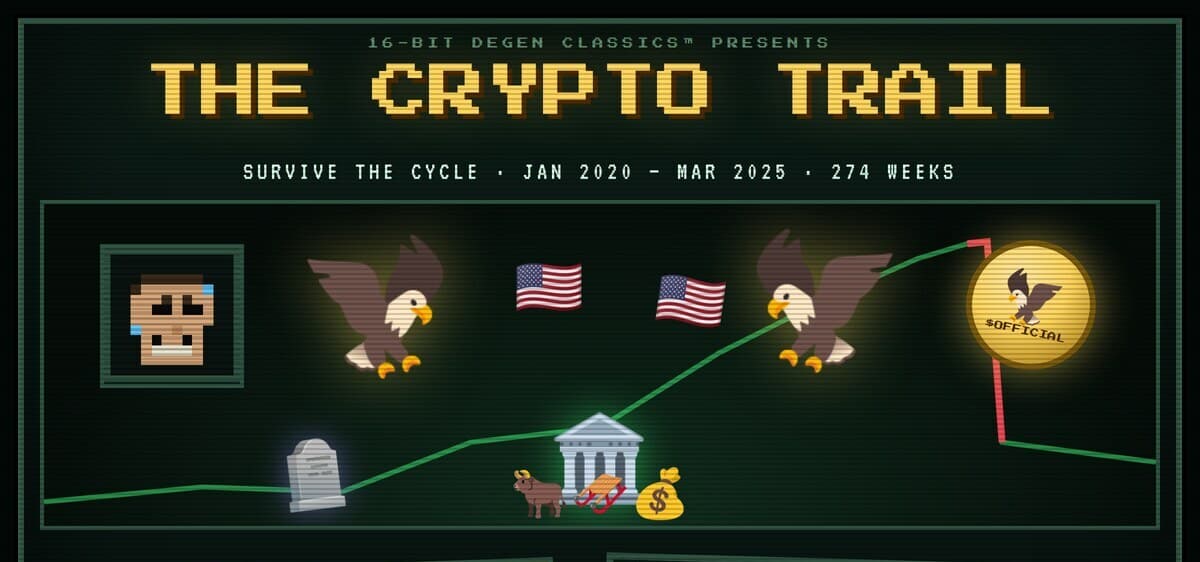
The Thesis
The dysentery of our time
“Cause: hemorrhoids. Sixteen-hour chart sessions.” The game never breaks character, never encourages you, and never pretends the frontier was survivable because you were smart.
Replayability
No two trails run the same
274 Weeks, One Cycle
January 1, 2020 — BTC at $7,355 — through March 31, 2025. Every week is a turn. Sixty-eight landmarks are pinned to the real historical week they happened: Black Thursday, Solana mainnet, the stimmy, the Ronin hack. Specificity is the nostalgia.
Arcs That Collide
Around twenty major story arcs, gated on combinations rather than a linear script — class × city × party × portfolio × who's in your cabal. The Boston Protocol needs Tea Party and London. The Visa Question needs journalist and Pyongyang. Most runs never see most of the game.
Difficulty Is Emergent
There is no difficulty menu. Six classes, nine cities, five parties — one of each hidden — multiply into the challenge. Journalist in New Delhi under the Tea Party is the hard mode, and nothing in the UI ever tells you so.
Solana · $NGMI
Every token spent in game is burned
$NGMI launched on pump.fun and rode the bonding curve like everything else in this game's universe. What makes it unusual isn't the launch — it's that the token has exactly one use, and that use destroys it.
There is no treasury, no escrow, and no custody. The player's own wallet signs a BurnChecked instruction and broadcasts it directly; the server never touches funds. It only reads the chain back to confirm the burn happened, and requires the transaction memo to match a server-computed recipe so nobody can watch the chain and claim someone else's burn. Every burn comes back with a Solscan receipt. Nothing is won. The supply does not come back.
Gild a run
$3Your run wears a gold outline on the leaderboard. Vanity, priced honestly.
Guarantee impressions
$3 / $11 / $18 / $80The next 10, 50, 100, or 500 travelers to reach your week will see your stone. Not a chance — a count that decrements.
Write over a stone
$20Deface someone else's epitaph. Theirs stays, struck through. Yours goes on top, signed.
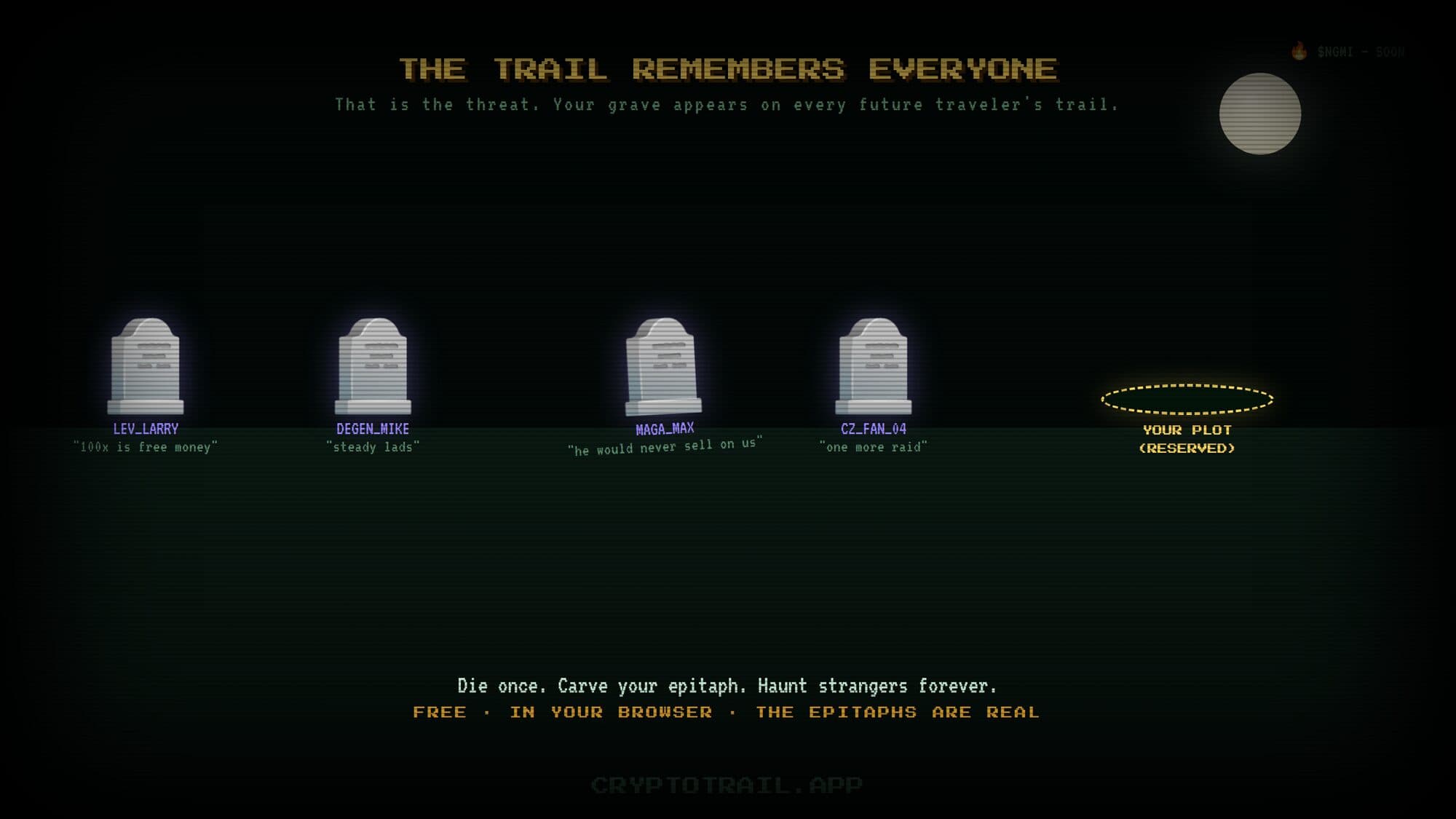
Tombstones
The dead get stones. The living pay to be read.
This is the mechanic the whole economy hangs on, and it works because it inverts what you'd expect a token to sell.
Carving is free. When you die, you type an epitaph — sixty characters, no more — and the stone is pinned to the exact week you died at. It sits on the trail map at that mile. Finish all 274 weeks instead and you get a flag rather than a stone, and you choose which mile it flies on. The dead get stones. You finished, so you get a flag.
Being seen is what costs. An unpaid stone is rationed hard — a 35% roll, a twelve-week cooldown, and only the most recent forty in the pool at all. Burn $NGMI and you skip the ration entirely: the next 10, 50, 100, or 500 travelers who reach that week will see it, and the counter ticks down by one each time a real person reads your line. When it empties, you fall back into the crowd.
Then someone writes over you. Any traveler who walks past your grave can burn $20 of $NGMI to deface it. Your epitaph isn't deleted — it's rendered struck through, faded, with their words carved on top and signed “written over by [name], who paid for the privilege.” The dead cannot object. Anyone with a wallet can answer you the same way.
That last part closes the loop. Defacement is an insult that invites a retaliatory burn, which invites another, and every round of that argument permanently removes tokens from supply. The deflationary pressure isn't a tokenomics chart — it's people being petty at each other across a graveyard, forever.
Gates keep it honest: a stone can only buy impressions if the run survived to week 52. Nobody sells ad space on mile one.
The Room
Your save file, drawn on a wall
Most games show you a stat sheet. The Crypto Trail shows you a bedroom at night — 1,159 lines of hand-drawn canvas, a fixed camera on the corner, city out the glass. There is no avatar. Just an empty chair seen from behind, because the player is the seat. The design rule was simple and expensive: every event that can mark the room should.
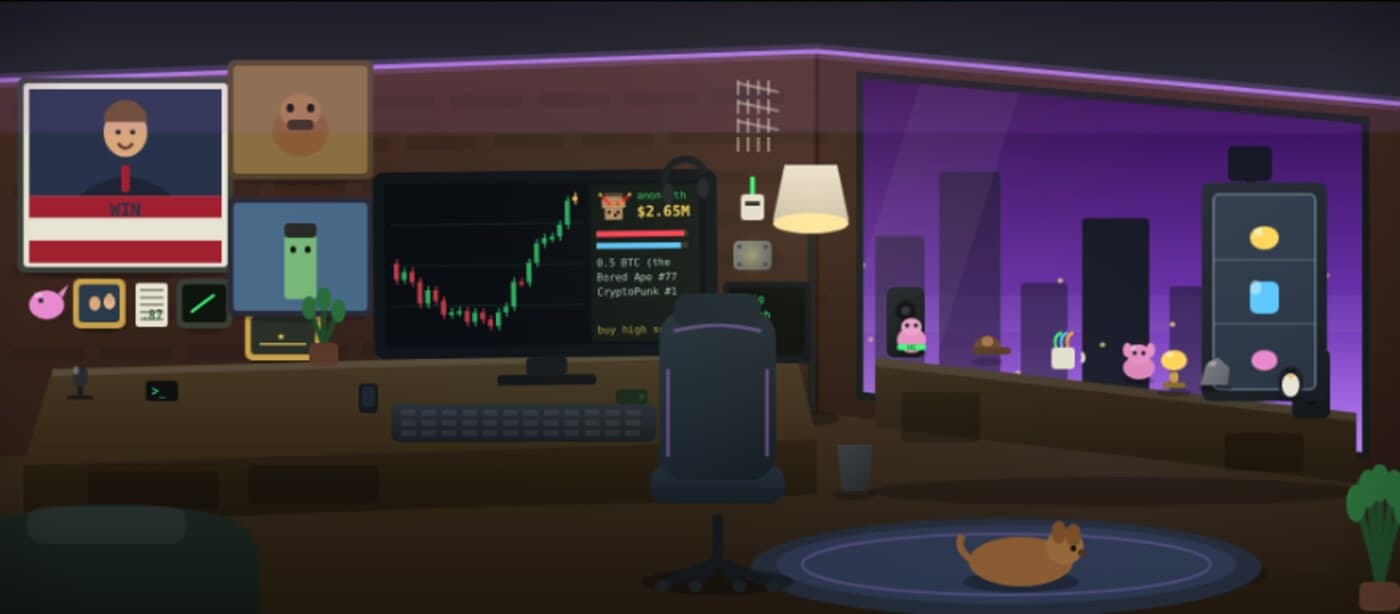
Apes on the wall, a dog on the rug, the city lit purple behind the glass. Every object is something you actually bought.
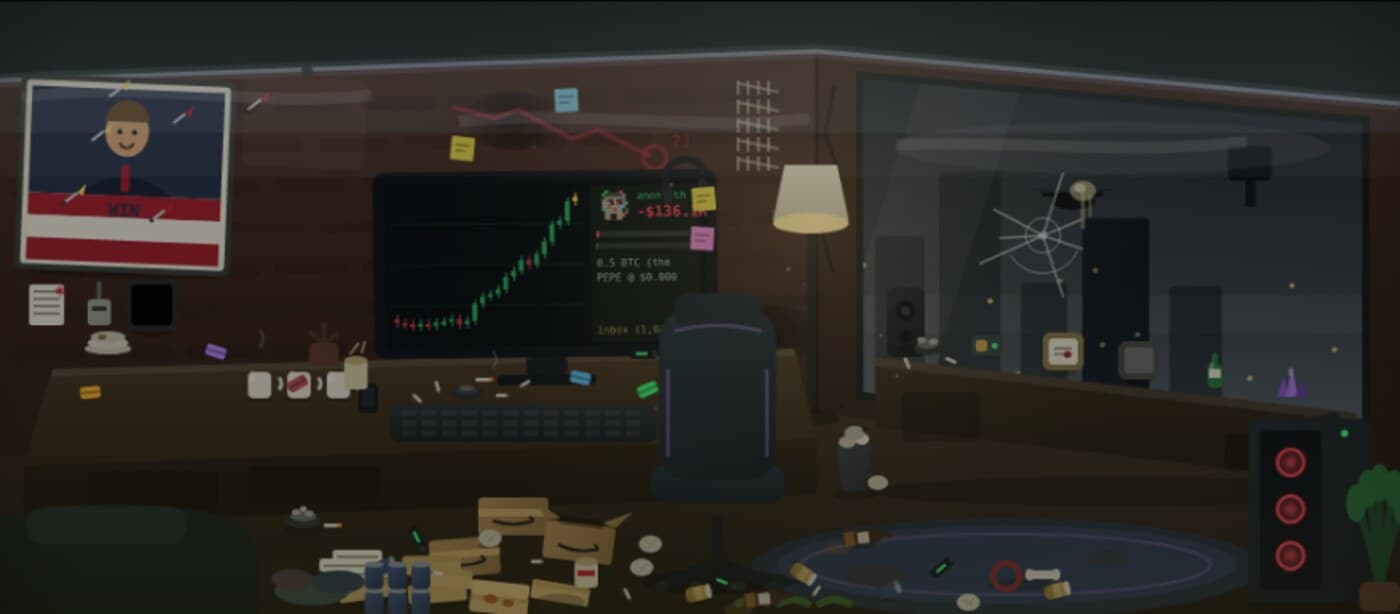
Same apartment, same camera. The chart went red, the trash tiered up, the collection came off the wall, and nobody came to take the boxes out.
Integrations
Wired to the chain, dependent on nobody
Wallet Standard
Wallets self-register — no adapter libraries at all, with a thin legacy fallback that detects Phantom.
Solana RPC
Mainnet, swappable to Helius by env var. Roughly 2 requests/second, and never any server-side polling.
DexScreener
Live price and market-cap oracle so burn costs stay dollar-pegged. Cached sixty seconds.
Jupiter
A prefilled SOL → $NGMI swap button sits in the in-game ticker banner.
Solscan
Every burn returns a receipt link. The chain keeps the receipt.
Caravans
Self-serve referral codes ranked by what each caravan's travelers burned, counted by device rather than IP.
Trail Wrapped
A 720×900 share card rendered on canvas at the end of every run. Every death is marketing.
The Board
Survivors ranked by score, then the dead by weeks reached, with server-side plausibility checks on every submission.
Zero dependencies
Vanilla JS and canvas, a 522-line Node server on node:sqlite, and no analytics of any kind. The dist is one HTML file you can open from disk.
Take the trail
274 weeks between you and the Inauguration. Arrive alive, sane, solvent, unindicted, and housed — with the biggest bag you can manage. Most people don't.
Play at cryptotrail.app